By Dr Haruna Penni
This play was scripted by Mallam Denja Abdullahi a former Association of Nigerian Authors (ANA) national president and an ex director of performing arts with the National Council for Arts and Culture. He was commissioned to write the play by Dr Usman O. Akanbi, current ANA national president who was on the cusp of a rerun back to office for a second term.
The non-fee entry drama would have netted a box office . But it was freely organized as the Convention Play for the 44th ANA International Convention and Annual General Meeting and Election which held between 31st October-.2nd November, 2025. This was done to commemorate 40th memoriam of the demised General Mamma Vatsa who granted the writer’s village land when he was the Military Administrator of Nigeria’s Federal Capital Territory in 1985.
Vatsa was moved to donate this sizeable chunk of land, according to insider information, based on a visit to a Scandinavian country. He was taken to their writer’s sanctuary and this triggered him to have similar resort for Nigerian writers as he was one. He felt that would be a worthy legacy on the part of the administration which unfortunately killed him.
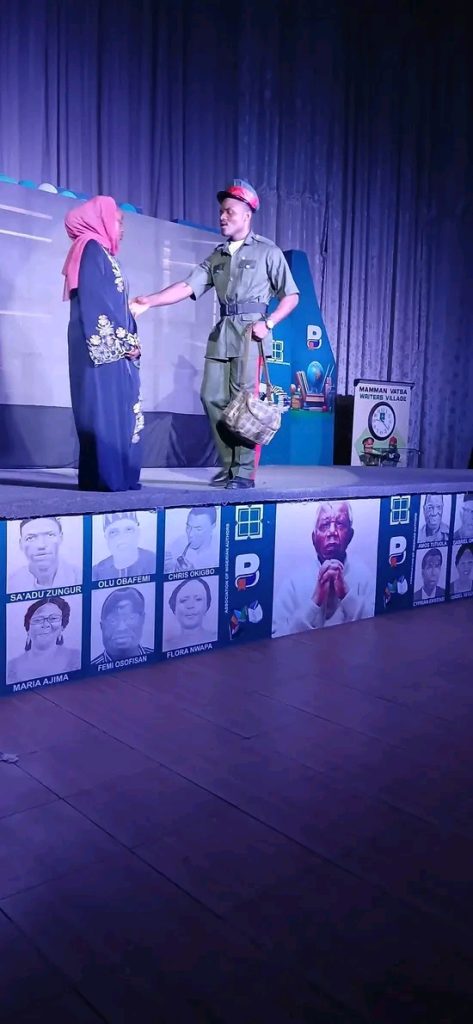
The play was performed on the Friday October 31, 2025 during the 44th ANA Convention and AGM held at the Chinua Achebe International Conference Centre at the Mamman Vatsa Writers Village at Mpape Abuja. About thirty five ANA state chapters who attended the 2025 convention and AGM watched the drama.
Maman Vatsa was a Nigerian general, poet, and administrator. He was born in 1940 in Vatsa town Niger State and was a prominent figure in Nigerian literary landscape, military and the IBB administration. He specialized in writing poetry which mostly delves on issues of Nigerian culture, identity and social observation.
One of his poetry volumes from which which Denja Abdullahi modeled the title of the play he wrote about him ‘Tori For Geti Bow Leg’ is a scathing exploration of Nigerian identity, complexities and culture. The play’s use of pidgin English adds a layer of authenticity, while the characters’ struggles resonate deeply with the poems thematic thrust and the playwright’s script.
Sadly, the play chronicles Vatsa’s last days. Although, he has other works apart from Tori For Geti Bowleg which he published in 1981, but all of them, speaks to his penchant for social commentary. This works include Back Again at Wargate and Reach for the Skies published in 1982 and 1984 respectively.
The production of Denja’s ‘Tori Don Geti Bow Leg’ was well-crafted, with standout performances from the cast. The play explores the tensions in the military occasioned by coup d’état amongst the offices corps, who tag themselves as Officers and Gentlemen. The Vatsa’s obnoxious coup scenarios sends panic to the authorities; opens up ambitions, exposes betrayals, breaks-up families and caricature of the rule of law, as well as the struggles for the survival of a regime.
Most of Vatsa’s works as earlier alluded to have themes that critically examine the complexities of Nigerian identity, including the interplay between the military class and civilian political groups. And a military regime and horrible civilian administrations would not like such exposure. Notwithstanding Vatsa’s powerful pen, his career got to its crescendo with the same regime headed by his former Bida secondary school head boy. He reconfirmed him in his appointment as the military administrator of FCT and a member of the two military ruling councils.
The ..Bowleg poem like his other works are all a critique of the Nigerian societal norms and power structures which he found obnoxious.
The military and other despotic governments do not like dissention, ‘too know’ and criticism of their polity as they view them as equivalent of coup. And perhaps their marabouts may also have the long hands in identifying their potential nemesis. Could it be the reason he was roped in what ANA believed was a phantom coup out to silence the critic? Some have even alleged that the so-called coup was a mere disagreement Vatsa had with the Commander-in-Chief in one of Council meetings. And there is also that alleged angle of personal rivalry between them right from secondary school; a rivalry akin to that between Gen Yakubu Gowon and Col. Emeka Ojukwu.
Technically, the plot structure of the play is not only engaging, coherent, and well-paced but had no inherent plot holes or inconsistencies that may mire plays of such nature. The characters were well-defined, relatable, believable and they drive the plot forward. These characters include Generals Ibrahim Babangida, Mamman Vatsa, Salihu, Lt Col. Ubah, Professors Wole Soyinka, Chinua Achebe, J.P Clark , Sufiya(Vatsa’s wife) etc.
The dialogues are natural, concise, and revealing of the characters without any awkward or forced conversations, while the themes and symbolism are clear and effectively conveyed. This is because the symbols and motifs were effectively used.
One unique selling proposition of the play was that tension and conflict were well-built and resolved satisfactorily. This goes with its pacing and timing which were well-balanced having no slow or rushed moments. However, the setting and atmosphere could not be effectively created and be immersive as to support the story, since army barracks condition could not be recreated on the podium.
The language and style of the play were rich, evocative, and fitting for the characters and setting, while the stage directions and production were clear and effective. This was because the production was well planned for about a months at Nasarawa State University Keffi, using its theater and cultural studies students and graduates. The managers too are experienced persons who also studied or practised theater arts.
The plot summary involves the court marshaling of Vatsa by the military tribunal, firing squad and the attendant saga miring the whole episode. The play’s themes are appropriate because so many Nigerians did not believe he committed any coup and the right characters were used to pull through the story. And the stage lighting, set design and sound were in order as they did not disappoint.
The message and impact of the play convey a meaningful meaning by leaving a lasting impact on the audience on the tragic coup allegation which comes with collateral damage as merely hearing its rumor makes one part of it. The opinion and recommendation of this reviewer is that the play was well crafted and executed technically by professional producers and directors while the cast have a long career ahead of them with their excellent performance.
It is also suggested that the play be taken round military formations to underscore the other side of coup. The fleeting nature of an artiste’s vocation is a sore point otherwise it is recommendable that the boys and girls who played their characters very well be held together by the production outfit which is Orpheus Literary Foundation.
The apparent strengths of the performance are both in the thematic thrust and the ability of the producer to blend live music and dance in the overall movement of the play. This was both electrifying and exhilarating as it was exhibitive of the young ladies alluring talents in other sub sectors.
The play’s weaknesses, if there is any, will be in not lending the storyline to easy decoding and interpretation while the characters were visibly not body double of who they represented in real life. Military uniforms can always be hired from the forces public relations for good causes instead of getting them produced by Obiomas of this world.
When ‘Tori Don Geti Bowleg’ play is compared to the same drama staged by the producer especially in his ‘Death and the King’s Grey Hair’ which this writer saw performed a few years ago by IBB University drama troupe in Lapai, one can only factor on time frame, cost and the technicality of operating the military outside the known military environment.
And there is that fear of negatively characterising the patriotic Nigerian soldiers who at this time are busy putting their lives on the line to defend us. A security guard once told this writer that after God it is the Army thus underscoring the fact that one needed to tread cautiously with anything of theirs.
Perhaps, ..the King’s Grey Hair is more amenable to dramatization. And after all, the Vatsa’s play is a one way script revolving on the coup that silenced him, instead of the actual theme of the poem by atsa himself. Nevertheless, it is to the credit of the playwright that he was able to put together this commemorative script and play within the shortest time available.
,
The dominant theme in the play is that refrain of coup, its kangaroo trial processes and its traumatic after effects of guilty sentence and firing squad. So the militarization motif of the play is not misplaced as this is mildly explored in the dramatic gamut: parade, coup, salutation, court martial, killing as earlier narrated.
Of course, the play leaves a lasting imprint in the minds of gullible civilian audience. They were exposed to military legalism, lifestyle of bereaved army families and its consequent trauma processes. This is even though the creatives are not themselves innocent as they too have also birthed and killed characters in their works from the act and art of playing God.
The producer and the directors (Oko Owi Ocho and Jibril Ahmed) executed this task with a 15 member cast which included James Onawo, Yepwi P. Ishaku, Mordi C. Chukwunonso, Alidzi G. Joseph and Uchenna P. Martins. Others were Oloko Owokonu, Ibe K. Lucy, Ogah A. Akeji, Okoro M. Chinasa, Emmanuel H. Haruna, Mmaju Favour, Cletus Amuda, Oboshi E. Innocent, Godwin J. Onawo, and Jude F. Terkuma.
The partners in the task were Orpheus Literary Foundation, Abuja Poetry Troupe with generous support from Brigadier General Hassan Lai(rtd), KMVL Ventures, Mrs Awele Ilusanmi, Prof Idris Amali, Prof Udenta Udenta and Gen. Mammam Vatsa’s family and of course the Association of Nigerian Authors.
The playwright and producer Mallam Abdullahi Denja was born on 27th August, 1969 in Idah and hails from Agbaja in Lokoja Local Government of Kogi State. He attended universities of Jos, Ilorin and Abuja for his three degrees in English Language and Literature.
He is a prolific playwright, poet, essayist, cultural administrator and one-time national president of the Association of Nigerian Authors (ANA). A former lecturer with The Polytechnic Birnin-Kebbi, now Waziri Umaru Federal Polytechnic, Birnin-Kebbi, in the early 90s. Denja later transferred to the National Council for Arts and Culture and retired as a director in 2023. He is the chairman Orpheus’s Literary Foundation, promoter of Agbaja-Plateau Writer’s Residency and a fellow and merit awardee of ANA, ICPAN, NPOM and SONTA.
Dr Haruna Penni is a freelance literary journalist and communications policy analyst on 08034299585.