
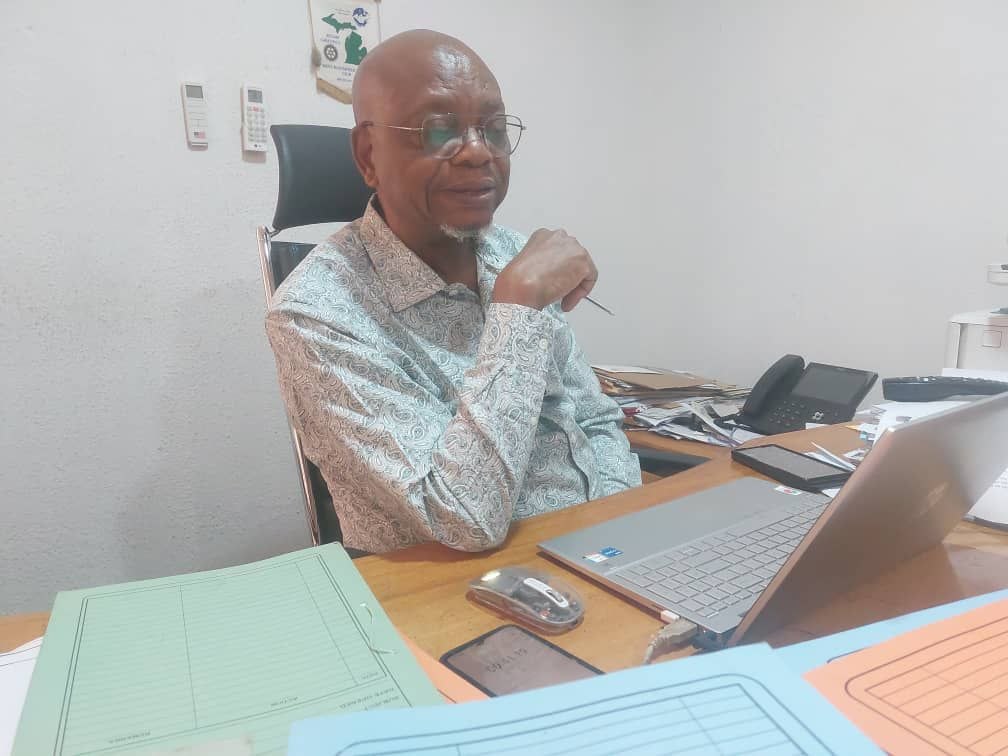
Mayo Ayilaran, DG and CEO of Music Collecting Society Nigeria, MCSN, has thrown more light on why churches and mosques in Nigeria cannot pay for the songs they play during there services or special events for now. He spoke on other copyright issues in this exciting interview.
Tell us the progress you have made so far in establishing branches across the country
Well, it has been a challenging journey, but we realized that to cover the whole federation, both landscape and population of over 240 million, you have to do that by setting up offices in virtually all the major cities.
But, you can’t do that at ago, you have to start with one step at a time. Initially, we were doing that using the agency structure . We set up the agency structure and then give people the agency job. They act as our agents and as we moved along, we discovered a lot of faulty lines.
So, we decided that rather than continue with agents, the society will set up offices, staff the office and then operate directly. If there’s need to have an intermediary agency, the office will be closer than it used to be.

Where we are in Lagos, somebody will be running an agency in distance place like Enugu or Port Harcourt and monitoring will not be effective. For that reason, we have established at least four solid branch offices in: Abuja, Benin, Ibadan and Akwa Ibom. The one we have in Uyo, Akwa Ibom is not yet functional because we have not been able to complete the furnishings. We want the society to be close to those we are licencing.
We are servicing two kinds of clienteles. First, we are servicing our members who are spread all over these places. They feel happy if they have a branch close to them where they can walk in and lodge their complaint. The other aspect is that we service those who are using the music. So, we are like an intermediary between the music and the user, that’s the creator of music and the user. So far, we have done very well and we are building on it .
We must know that organisation like this is highly capital intensive. People say we go out to collect money, the question is, is it easy to collect the money from anybody. Even when the economy was good nobody will easily part with money, you have to defend it and fight to get them obey.
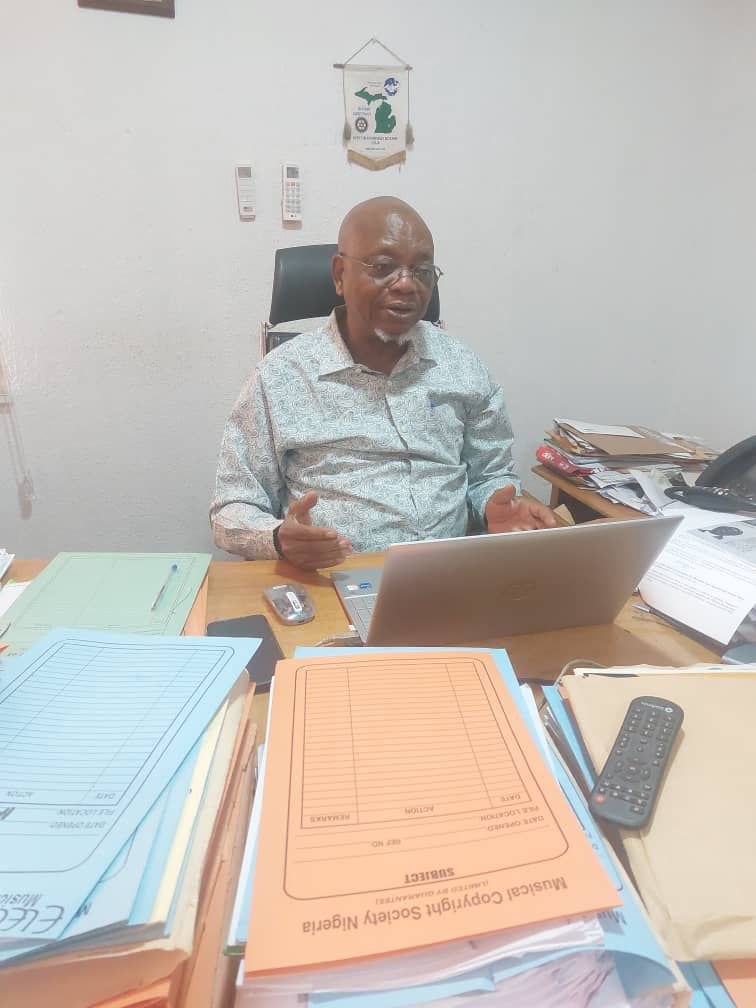
This is an organisation that nobody capitalised from the beginning.It’s the administrators that put in their thinking cap to see how they can scrap money here and there. Even when you go to bank to take a loan, the bank will say your business is not clear to them. We understand them, we are dealing in intellectual property, banks are interested in what they can see.
Generally, the knowledge and information of copyright is still very inadequate in this country vice avis in other countries. And people who claim to know do not know how it operates. For example, some musicians will say my work is playing so and so, and I am supposed to be paid millions of Naira. The people using your music, have they declared profit in millions. Again,, are they ready to pay?
We are engaged in serious fight with most of these people and the biggest users in the county are government agencies and broadcasting stations like FRCN and NTA, not to talk of the ministry of information. These agencies are heavy users of music and when you go to them to pay their copyright levy, they will fight. They will tell you, they are helping you to propergate your music, but I believe persistence is the name of the game.
We will persuade them and at the end of the day, we may have to apply the law because there’s a law and as government agencies, they must lead in obeying the law.
Under Section 89 of the Copyright Act 2022, a 5% levy applies to certain electronic devices, storage media, printers, and phones to compensate rights holders for private, non-commercial reproduction. How do you intend to get this levy from small retail users?
What we are saying is a difficult task, but we will do our best to persuade and document but, the last option is litigation. You mentioned the copyright levy scheme. First, we have to give FG under President Tinubu commendation for implementing that section you have pointed out. We have had such provision way back since 1988.
People have been sweet talking, but no government has been able to bring it into action which this present government did. They have made the customs to be collecting the levy at least, at the point of entry. Assuming you are bringing in phones and flash drives, anything with which can be used to exploit copyright works, they apply that 5 per cent and they collect levy.
However as it is, we do not have a clear accounting of how much is being collected by the agency, which is the revenue collector in that area. It’s not only limited at the ports, they should also go into the assembly plant, local industry that manufactures some of these things within Nigerian and apply the levy and collect.
On the accounting side, we should be able to know how much was collected and on what. So, we can be clear that this volume of money is being realized from the creative sector. It’s just like tax which government wants to use as a major source of income generation for the country.
Government can say good revenue is coming from the copyright levy and the way it’s being shared, it appears government is taking like 50% of the money. Government too should make the system accountable rather than leaving the custom to determine how much they will give the people who are really the beneficiaries of that fund which we are scratching on the surface.
Have you taken this up with the NIgerian Customs?
We have not . We have tried to ask, but the system is still shrouded in secrecy because when you get to a table, they will tell you that they do not know about it. When you probe further, the whole thing fizzles out and you get frustrated. These are some of the things we need to straighten out though we are just starting.
From our nature we do not see problem as a tool for abdication. We would want to find out how it works. Is it the same way the agency is collecting duties without giving government a break down of what they collected and how, and what for. We need to understand and compare notes before we will raise any dust.
You once said Nigerian musicians are not beggars. On what basis was that comment made?
I was looking at their potential and consumption of Nigerian music. When you look at their potential, you can conveniently say Nigerian musicians are not beggars and they should not be because if the law should be implemented properly, Nigerian musicians should be one of the richest in the world, rubbing shoulders with their counterparts across the world. But, when the system makes it difficult for them to get their money, just like I gave you the example of FRCN.
If a government agency like the FRCN is not paying their due royalties, even discounted royalties due to these musicians, what’s the justification. When you look at the broadcasting stations across the world, and you put the whole lot together and they pay 10 percent of what they ought to pay,Nigerian musicians would have something good to fall back upon.
But before we get to that, they have stressed the system and make us pay heavily to get them to do what is right. Then, if you say you want to go to court, you will calculate how many years you want to stay in court before you get judgement from the court of first instance. By the time you get the first judgement, they may appeal and it may take between 5-10 years for the Court of Appeal to determine that case, and if they are still not satisfied, they will go to Supreme court. When you look at the process, you can see that it’s a tall order for us, but we will persist.
Music platform like Spotify is making it difficult for music artistes to acknowledge your work since they can also make money from that platform. So, how are you working around this ?
The way I look at it, Spotify is doing its own business to survive and make profit. They make their profit majorly through advert. People go there, listen to music but when you are listening, they break it with adverts. When you feel frustrated that you don’t want to be obstructed, you will subscribe and become a premium subscriber.
The question will be, is Spotify paying the due royalties locally. Initially they will say they have settled their bill being a platform whose origin is based in Geneva, Switzerland. They have settled the society in their country but, Where we have have been able to pin them down is that many Nigerians are subscribing and you are making naira and whatever payment attached to that naira, you must pay it locally.
Many of the adverts were sourced from our territory and it’s the discussion we are having. That’s how we are hoping our own stake in the African network system because we belong to a pan African licencing scheme. This is being handled for us and other societies within African hub by our south African sister society. CAPASSO (Composers, Authors and Publishers Association).
With this, they deal with Spotify. There is YouTube, which will not answer you quickly because they are based in America and have done everything. But we thank the government particularly the National Assembly who is looking into the copyright matters and how this foreigners are complying with Nigerians law.
The interconnection between copyright and intellectual property is complex because where you think your right is, by the time they start to twist the law for you, you may find out that you have no right anymore at the end of the day. Look at the telecom companies, they claim they are only selling their data, but without their data, can you access YouTube, can you access Sportify,.
Our argument is that you provide the vehicle through which our rights are being exploited. You either compensate us by part of what you gain from that vehicle or we knock down the vehicle entirely. If you don’t sell data to me, I will not be able to use YouTube or share music.
It’s worse now that people will just pick somebody’s music out, put it on their images and then post on YouTube and Facebook and music will be playing at the background without recompense to the owner. If you go to that person, he will say, it’s a private use, I am in my room celebrating my birthday and I am playing the music to celebrate myself. But can we say it’s private when thousands of people are viewing it and are liking it. Some people are building it into content creating. The source is what we will need to look for .
We are not asking for something much. If someone buys a data of #100 and we ask you to give us #10 out of it, it won’t be too much. Within this demand you have the freedom to negotiate. It’s unfortunate that this is coming rather late in the day because the time all these arguments should have come even within the system, those of us within the copyright sector were busy fighting ourselves rather than corporations.
We can corporate to have this money, when it comes, we can go home and fight ourselves for the share. We are fighting ourselves, stopping everyone of us from accessing the money and the people using the money are happier. Anytime you go to ask for the money, they will say, but you guys are still in court.
What’s copyright disclaimer and at what point can one write it ?
Copyright disclaimer is saying if there’s any infringement of any copyright material in this product that we are going out with, we have no hand in it. That’s a disclaimer, meaning that you are not liable to any copyright infringements that occur. But, before you can do that there must be some arrangements between you and whoever is putting those contents in your system to have cleared the copyright.
So, if you put out a disclaimer to what you are offering to the public without properly identify who should be held responsible, you will still be held responsible inspite of your disclaimer because you have not done the proper thing.
If anyone sues me for it and I have to pay a claim, I will transfer those things to you. You fail to have done those things and you say you have done a disclaimer, it doesn’t work like that.
People say there’s no originator to Christain songs and the songs are not copyrighted. That’s why churches can play any gospel song , even artistes perform other people’s songs with out recourse. Is this proper?
It’s incorrect. The Christian songs you listen to were composed by someone. So, it’s covered by copyright.
Why do they play it freely in churches?
The only thing is that the law requires a church to obtain a copyright licence. In Britain and other countries, most churches have their copyright licence from the CMO operating in their various countries.
You can’t operate church and play music in Britain for example without having a copyright licence from PRS. The only thing they can allow you, if the music you are playing is for divine worship. Divine worship is when you go to your normal service, you sing the hymns during offering and pray. For you to say you are doing harvest, Kantata, or crusade, you deployed heavy music equipment, you must obtain your licence.
But here, we are too religious. If I should send a letter to any church to come and obtain MCSN copyright licence tomorrow, you will hear the president of PFN raining prayers of fire and brimstone on me and my company. They will interpret it as another war against Christianity.
So it’s a very delicate line, which we need to get to certain stage where people are properly educated before such happen. If they are well educated, after all the guest artistes they invite to their churches get paid very well and these guest artistes will go there and play other people songs.
Meanwhile they are going home with thousands of money for their appearances, but the people whose songs they performed did not get a dime, which is one of the bases to justify licensing those churches.
But we need to get to a level of understanding and education before you can implement it. So, there’s nothing in the book that says the church or mosque should not be charged for copyright.


